




Taxi Vouchers vs Cabcharge: What’s the difference?

Both Cabcharge and taxi vouchers are designed to make essential travel more accessible but the right one depends on your care supports, funding and circumstances.


Table of Contents
Being able to get to appointments, run errands or stay socially connected plays a big role in living independently. When transport comes up in aged care, two options are often mentioned: taxi vouchers and cabcharge.
They sound similar, but they come from very different funding sources and work in very different ways. Understanding the difference can make it much easier to decide what’s right for your situation.
Cabcharge: transport paid from your aged care package
Cabcharge cards, or similar provider-issued transport cards, are paid for through an aged care package, such as a Home Care Package or Support at Home funding.
This option covers the full cost of the taxi fare, with the amount deducted directly from the person’s care budget. Your aged care provider usually sets a weekly or monthly transport budget and loads it onto the card. The card works much like a debit card, making it simple to pay for transport without needing to handle cash or make claims later.
Cabcharge is commonly used for regular transport needs such as medical appointments, pharmacy visits, shopping or social outings. Because it is linked to your care package, everything is managed through your provider.
Taxi Vouchers: A separate government subsidy
On the other hand, taxi vouchers come from a completely different funding system. In New South Wales, this is called the Taxi Transport Subsidy Scheme (TTSS). It is a state government program, not part of aged care funding.
The TTSS is designed for people who cannot use public transport due to a severe and permanent disability. Age alone does not make someone eligible.
To apply, the individual must go through the relevant government authority, and the process usually involves medical information from a GP and supporting paperwork. Approval is not guaranteed, and many people find the process detailed and time-consuming.
If approved, the scheme generally covers up to 50% of the taxi fare, up to a capped amount. The remaining cost is paid by the individual at the time of travel.
More information about the NSW TTSS:
https://www.service.nsw.gov.au/transaction/apply-for-the-taxi-transport-subsidy-scheme
https://www.transport.nsw.gov.au/projects/programs/point-to-point-transport/taxi-transport-subsidy-scheme
The difference between the two
The main difference comes down to where the money comes from and how much is covered.
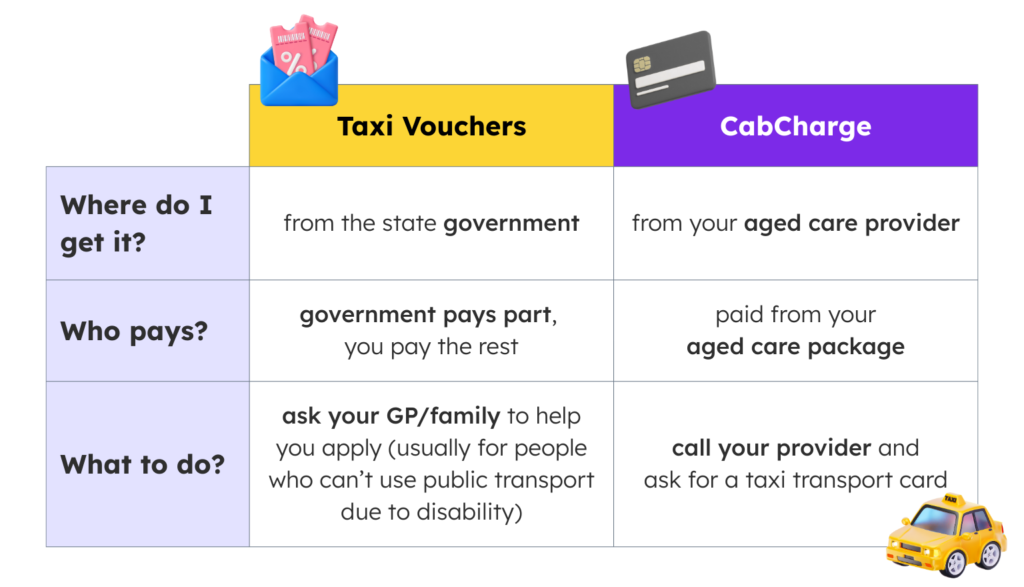
With Cabcharge, transport is paid for through your aged care package and usually covers the full fare, based on the budget set in your care plan.
With taxi vouchers, the funding comes from a state government disability scheme, usually covering only part of the fare, with the rest paid by the individual.
Because these options are funded separately, they are generally used one at a time. Using both for the same trip is usually not allowed.
Which option is right for you?
Some people who qualify for a taxi voucher choose to keep it as a backup, while using Cabcharge for regular transport through their aged care package. Others rely solely on Cabcharge for its simplicity and full coverage.
If you’re unsure which option applies to you, or how transport could be included in your care plan, it’s worth talking it through with your provider.
At Leora Healthcare, we help clients and families understand their transport options and choose what best supports everyday life and independence.
Reach out to our team today to learn more about these options.